
Extraction systems & down-drafts.
When flow, installation space
and separation
must align.
Filter and separation solutions for modern air guidance, grease separation, and compact extraction systems.
We develop metallic knitted mesh and separation structures that precisely adapt to design, airflow, and separation requirements – even where standard filters reach their limits.
What knitted wire mesh achieves in extraction systems.
Modern extraction and down-draft systems place particularly high demands on filter technology, installation space, design, airflow, and separation efficiency. Especially in compact and flat systems, flow, cleaning, noise development, and function must work together optimally.
- High grease separation – the intricately intertwined wire structure reliably captures grease particles and aerosols from the airflow.
- Flow-optimized – the open structure separates without unnecessarily constricting the airflow path – important for quiet, efficient, compact systems.
- Easy to clean – metallic knitted meshes are durable and, in many cases, dishwasher-safe, instead of ending up as disposable fleece.
- Installation space-flexible – geometry, packing density, and format are determined by the available installation space, not the other way around.
Applications
- Down-draft systems
- Range hoods
- Grease separation
- Kitchen and ventilation technology
- Compact filter elements
- Special solutions for design and functional components
Eloona develops technical knitted mesh and separation structures that adapt to the respective design and application. Metallic knitted meshes, material combinations, coatings, and special filter geometries are used to effectively separate fumes, grease particles, and aerosols from kitchen exhaust – for clean exhaust air and reduced grease deposits in the downstream system.
Three designs, one specification: which component suits your system?
Whether it’s grease separation in the hood, compact separation in a down-draft system, or aerosol separation in ventilation technology – the right solution comes from the right component.
Knitted wire meshes
The material core: knitted metal structure made of stainless steel, formable into grease filters, filter rings, and separation inserts. The basis of every custom-made extraction system solution.
Separation cassettes
For structured grease and aerosol separation with defined geometry – robust, easy-to-clean cassettes for hoods and compact systems.
Wound filters
Where fine aerosols and droplets occur, wound filter layers reliably separate them – especially with high loading in continuous operation.
Why knitted wire mesh separates where a fine filter would clog.
Separation is achieved not by a fine filter that clogs the airflow path, but by the structure of the knitted mesh. Three mechanisms interact.
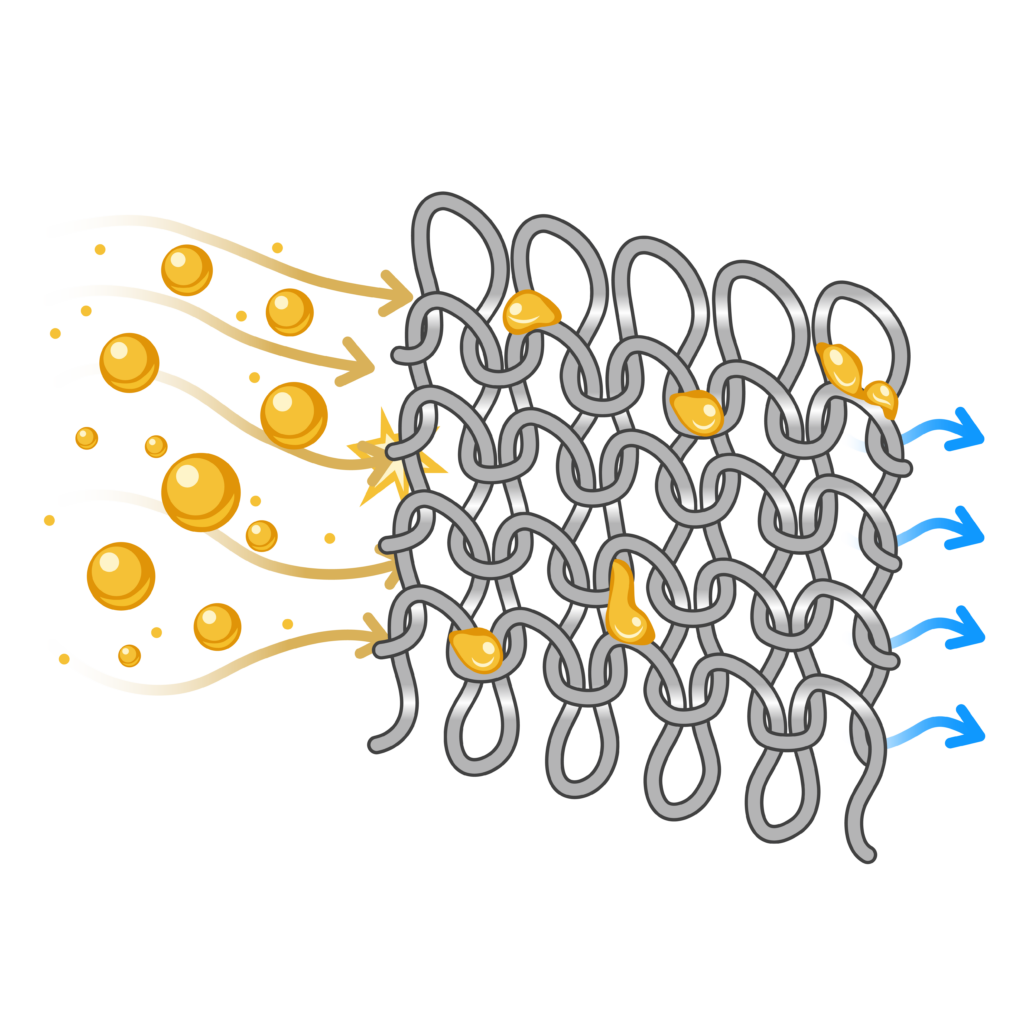
Inertial separation (impaction).
The grease-laden airflow is repeatedly redirected by the intricate wire structure. Heavy grease particles and droplets cannot follow the rapid changes in direction, impact the wires, and adhere – while the cleaned air continues to flow.
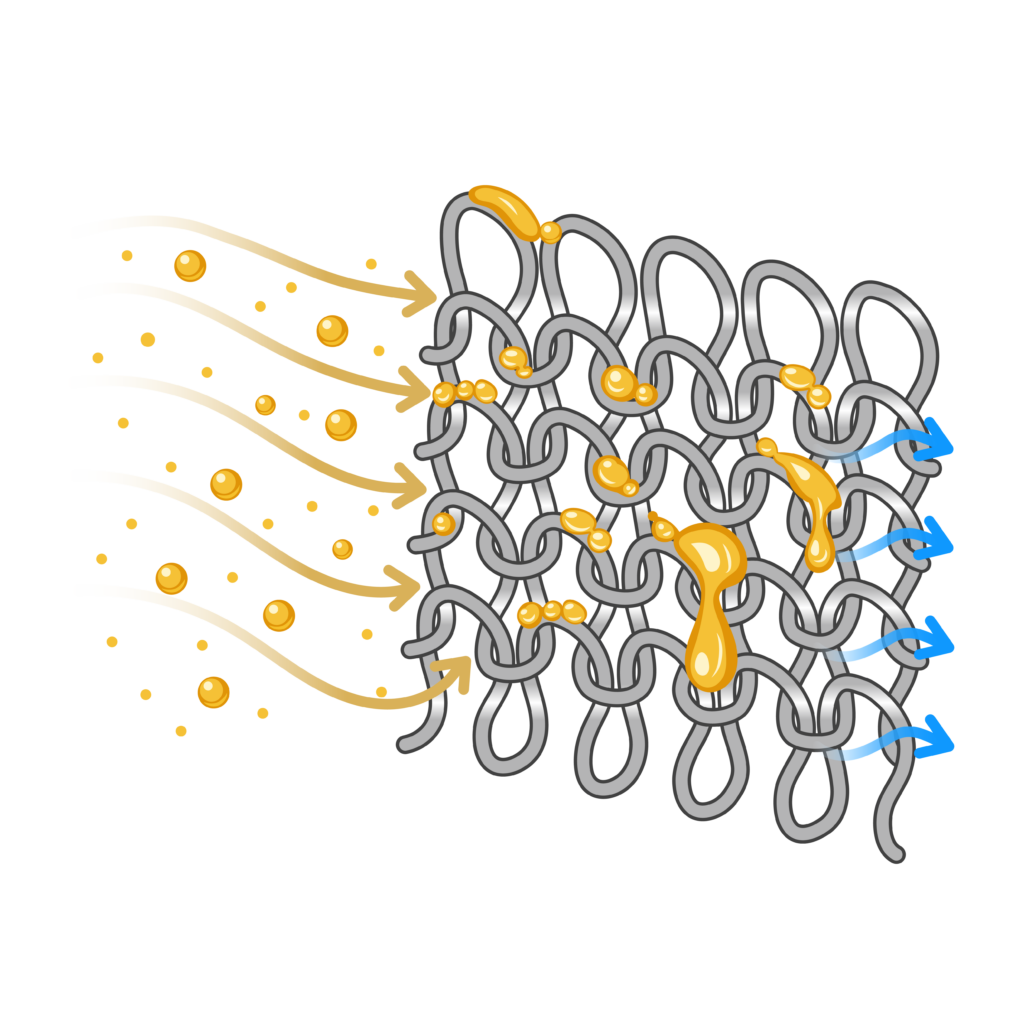
Coalescence of fine aerosols.
The finest aerosol droplets accumulate on the large internal wire surface and coalesce into larger droplets. These drain off and are collected – thus, even fine oil mist is separated, which a coarse mesh would let through.
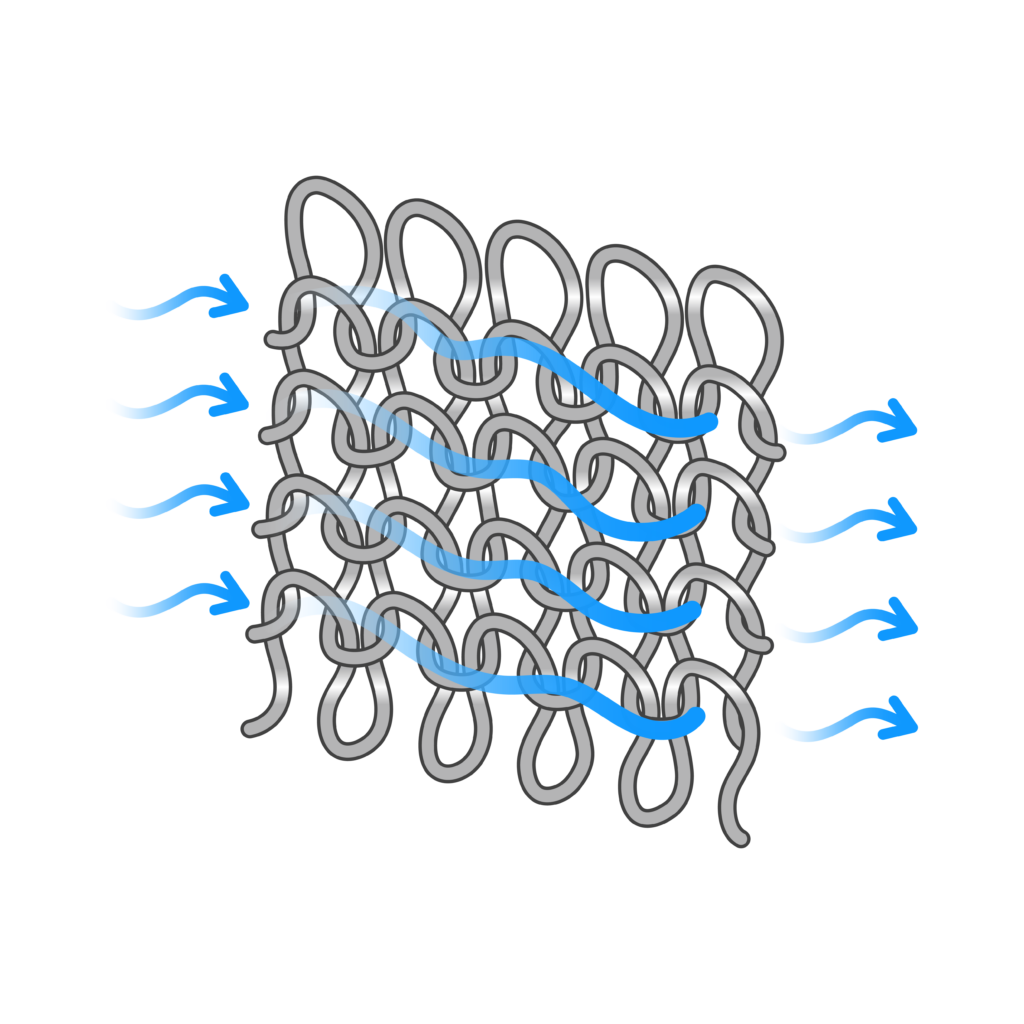
Airflow guidance with low resistance.
The open knitted mesh structure separates without significantly constricting the airflow path. This keeps the pressure drop low – important for quiet, energy-efficient, and compact extraction and down-draft systems.
How finely the knitted mesh separates and how low the pressure drop remains depends on the design – on four adjusting screws that we tailor to your system.
Adjusting screws for
your metal filter.
Four parameters determine how finely the knitted mesh separates, how low the pressure drop remains, and how well it can be cleaned. We tailor them to your system.
Packing density.
How densely the knitted mesh is packed determines the separation efficiency and the pressure drop. Denser means finer separation, more open means less resistance – we find the balance for your application.
Material & surface.
Stainless steel for durability, corrosion, and temperature resistance; if required, with coating for easier cleaning or better grease release.
Wire gauge & mesh size.
Finer wires capture smaller aerosols, coarser ones are more robust and easier to clean. The combination controls which particle sizes are reliably separated.
Geometry & design.
Ring, cassette, mat, or custom insert: form and format depend on the installation space of the hood or down-draft system – the component adapts to the system, not the other way around.
From these four adjusting screws, a component is created that precisely fits your system – not by chance, but by design.

Why eloona?
Because good grease separation is no accident.
Appliance manufacturers, kitchen and ventilation technicians, and plant engineers come to us when a metal filter needs to separate finely, generate little pressure drop, and fit into a tight installation space simultaneously. We develop custom filter components, not off-the-shelf products – tailored to the separation efficiency, flow, and design of your system.
Precise in separation efficiency. Clear in flow. Strong in installation space.
Frequently asked questions about extraction systems and down-drafts with knitted wire mesh.
How does a metal filter made of knitted wire mesh separate grease and aerosols?
Can the metal filter be cleaned?
Yes. Metallic knitted mesh filters are designed for repeated cleaning and, in many designs, are dishwasher-safe. Unlike disposable fleeces, they retain their function over many cleaning cycles – which reduces follow-up costs and waste.
What is the separation efficiency?
That’s precisely where it excels. Down-draft systems have limited installation space and require separation that works finely without constricting the airflow path. We precisely design the geometry, density, and format of the knitted mesh for compact systems.
How finely does the knitted mesh separate?
We control this through packing density, wire gauge, mesh size, and number of layers. High separation efficiencies can be achieved for larger and medium grease droplets; the finer the aerosols, the denser the knitted mesh must be packed – and the higher the pressure drop increases. The design is therefore always a balance between the required separation efficiency and permissible resistance.
Can knitted wire mesh be used as an aerosol separator?
Yes. Through coalescence – the merging of the finest droplets on the wire surface – the knitted mesh also separates fine oil and grease mist that coarse meshes would let through. This makes it suitable for kitchen exhaust and ventilation applications with high aerosol loads.
Do you manufacture custom metal filters?
Yes – that is our core business. We develop filter rings, cassettes, and inserts to match the installation space, connection, and separation requirements of your system. For appliance manufacturers and plant engineers, this results in components that can be precisely integrated, rather than forcing standard dimensions.
What material are the filters made of?
Stainless steel is common – durable, corrosion- and temperature-resistant, and easy to clean. For special requirements, special materials and coatings are possible.
How do I find the right metal filter for my system?
It’s best to describe the installation space, required separation efficiency, permissible pressure drop, and installation situation to us. Based on this, we will suggest the packing density, wire gauge, and design. A brief inquiry via the contact form is sufficient to get started.
Does your extraction system need the right metal filter?
Talk to us.
Whether you are developing a new extraction or down-draft system and designing the separation from scratch, or looking for a custom-fit metal filter for an existing system: We develop the component precisely for installation space, flow, and separation efficiency – from the first sketch to the ready-to-install component.
For a quick start, the following information helps us:
- Installation space and installation situation (hood, down-draft, ventilation duct)
- Required separation efficiency (grease, aerosols, oil mist)
- Permissible pressure drop
- Air volume and operating conditions
- Connection and mounting
So that flow, installation space, and separation align – in the most compact system.