
Cut protection.
When sharp edges meet
resilient structures.
Complex cut-protection meshes made from flexible metal knitted meshes and special structures to protect against sharp edges, tools, abrasion, and mechanical stress.
eloona supplies technical functional components for mechanical cut and edge protection – not certified personal protective equipment. The designer or plant engineer is responsible for the protective effect within the overall system; we supply the precisely designed component.
What knitted wire mesh achieves in cut protection.
Cut protection through technical knitted wire mesh is required wherever materials or components need to be protected from sharp edges, moving parts, or abrasive loads. Depending on the application, wire diameter, material, and mesh structure can be specifically adapted to the respective protective function.
- Cut and abrasion resistant – the metallic knitted mesh structure withstands sharp edges and abrasive stress where textile or polymer layers would fail.
- Flexible – the knitted mesh conforms to edges, curves, and moving components without rigid prefabrication.
- Mechanically resilient – contact pressure, vibration, and recurring movement do not alter the protective effect.
- Adaptable – wire gauge, material, and mesh size are designed for the specific cut or abrasion load.
Applications
- Technical component protection
- Edge protection
- Machinery and plant engineering
- Protective sleeves
- Flexible metallic protective layers
- Special solutions for abrasive environments
- Anti-vandalism cut protection (seats, truck tarpaulins)
Our cut-protection mesh can be fully integrated into a fabric or component structure without adhesives. This creates protective solutions that combine mechanical resistance, textile flexibility, and additional functional requirements – even for complex geometries and integration into existing systems.
Suitable products for
cut protection applications.
Depending on the application and protection requirements, different knitted wire mesh structures are used – from the base material to project-specific protective components:
Knitted wire meshes
The material core: knitted metal structure made of stainless steel or special alloys, formable into protective layers, sleeves, and edge protection profiles. The basis of every mechanical protective component.
Special components & protective elements
Cut protection, integrated into fleece, protective sleeves, edge profiles, and customer-specific cut protection layers are developed as an engineering service – designed for the type of load, geometry, and fastening.
How knitted wire mesh works in cut protection.
The protective effect results not only from material thickness but also from the structure of the knitted mesh. Three mechanisms interlock.
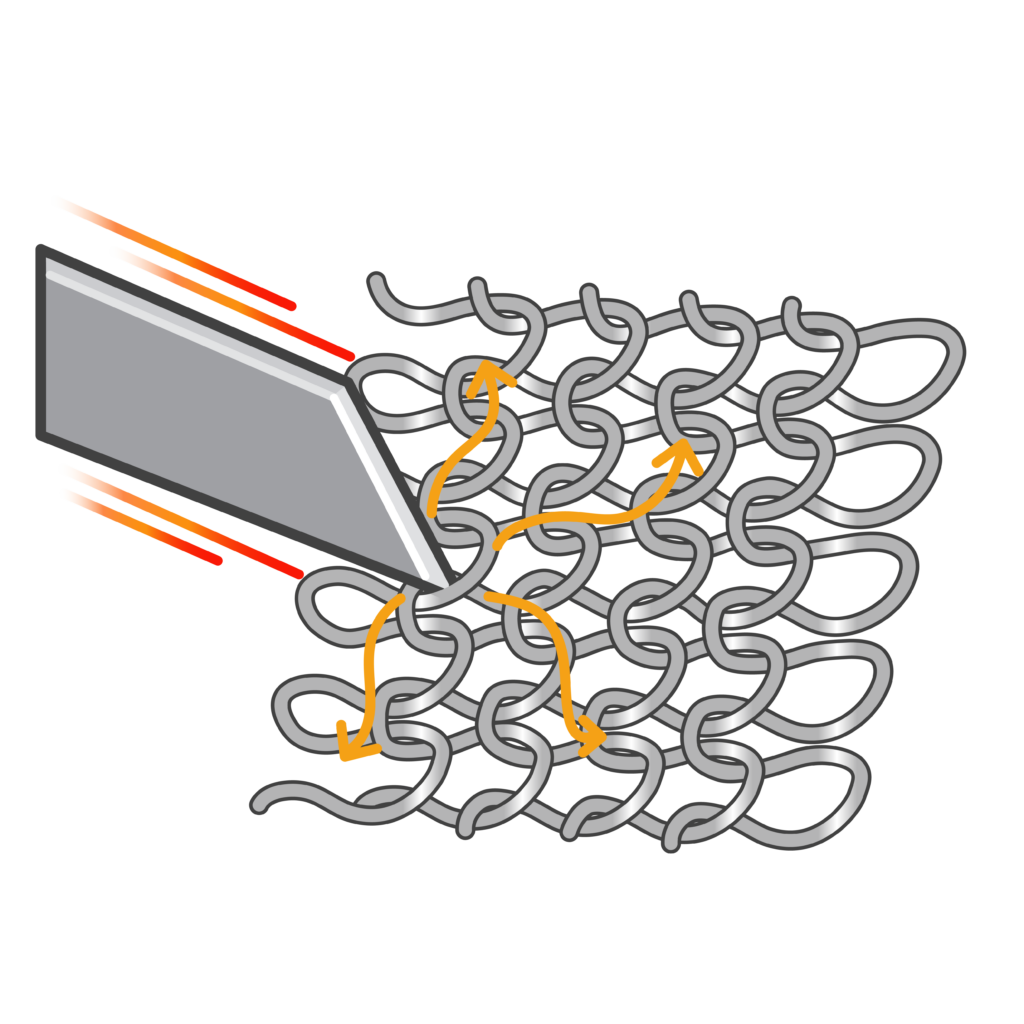
Multiple severing and loop evasion.
Here, a blade does not encounter a closed surface, but rather a multitude of independently movable wire loops. These yield and rotate under load – the blade travels a distance without performing cutting work – and must then be severed individually. A prerequisite is sufficient mesh density and fixation or connection to a substrate so that the knitted mesh is not displaced as a whole.
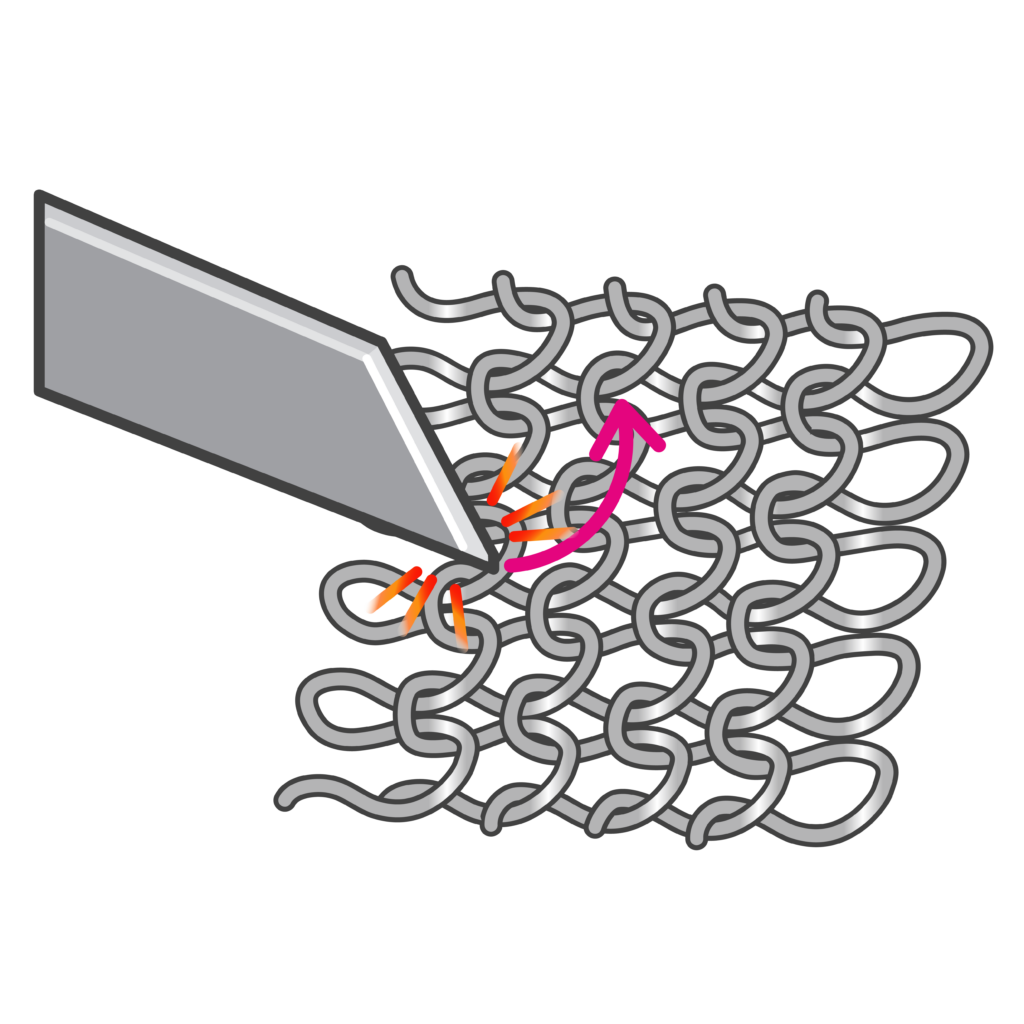
Blade damage and blade deflection.
The cutting edge, only a few micrometers wide, strikes round, spring-hard stainless steel wires. The load concentrates on a minimal contact point, causing the edge to roll over or microscopically chip – simultaneously, the wire curvature deflects the blade laterally from the cutting path. Both limit the slit length, which is the decisive criterion for testing according to NF F00-201 (utility knife, up to 150 N) and evaluation according to NF F31-118 (2013). In suitable configurations, our knitted wire meshes meet these requirements.
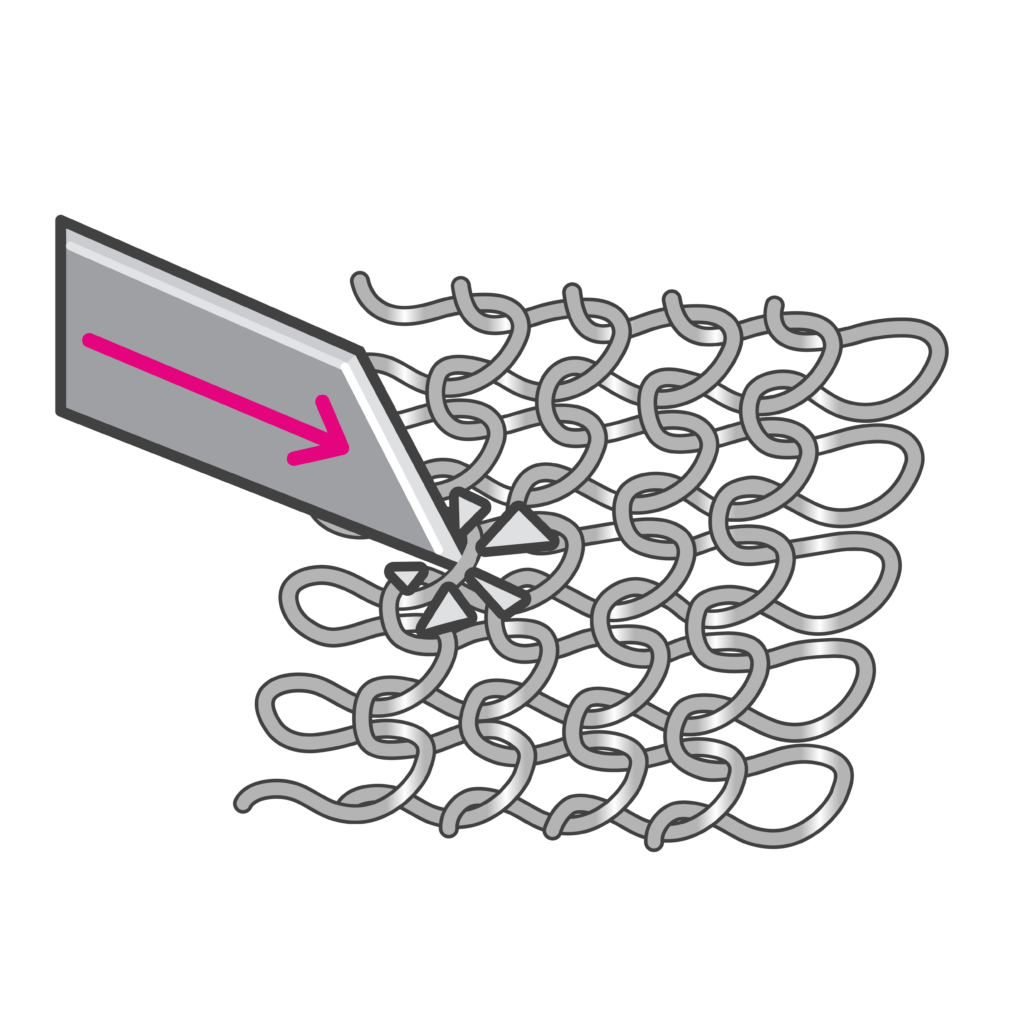
Wear distribution under abrasive stress.
Under abrasive load, it is not a rigid top layer that bears the stress, but a yielding mesh structure made of stainless steel. Material removal is distributed over shifting contact points instead of locally digging in. The achievable service life depends on wire diameter, number of layers, material combination, and degree of compaction.
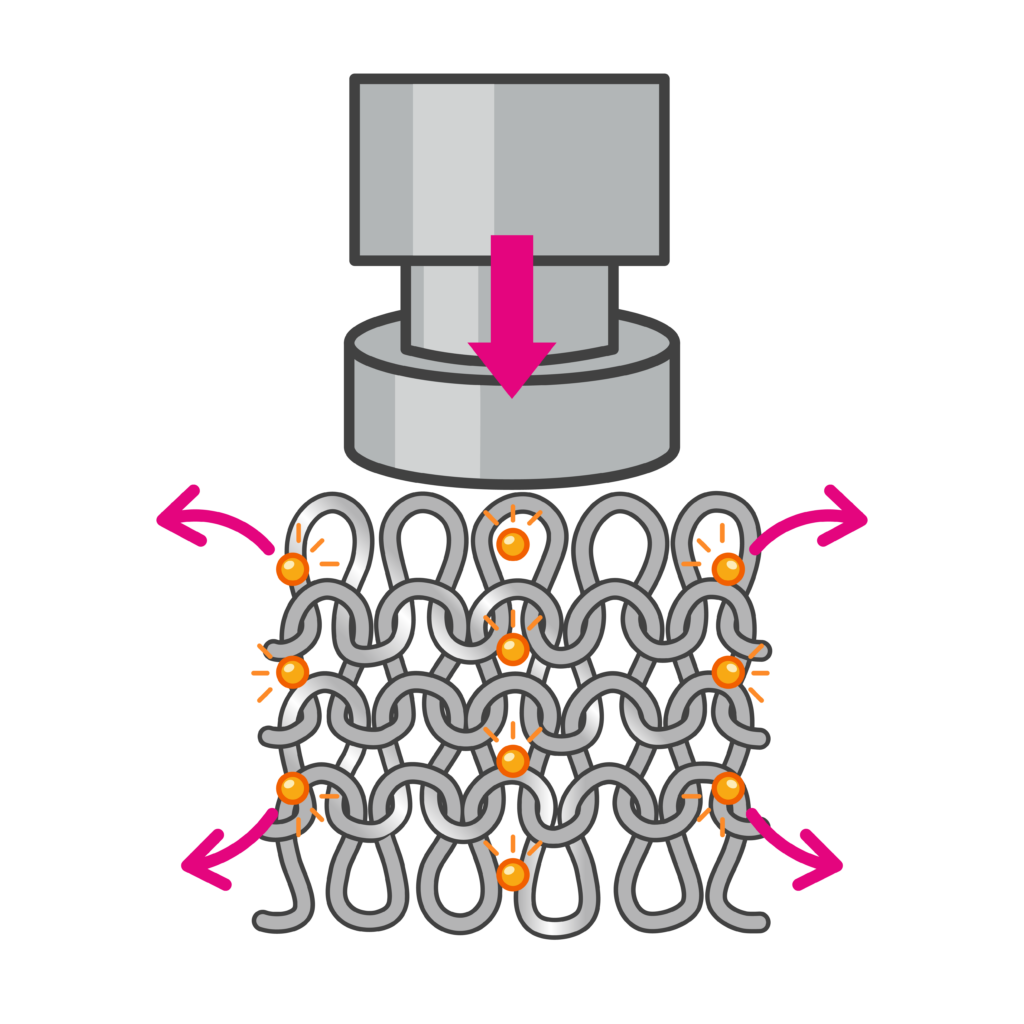
Energy absorption under impact load.
Knitted wire mesh dissipates impact energy through friction at the loop contacts. This property can be utilized in design but is considered separately from cut protection and is subject to load-dependent settling behavior, which is stabilized by pre-compression.
How pronounced this effect is depends on the design – on four adjustable parameters that we tailor to your application.
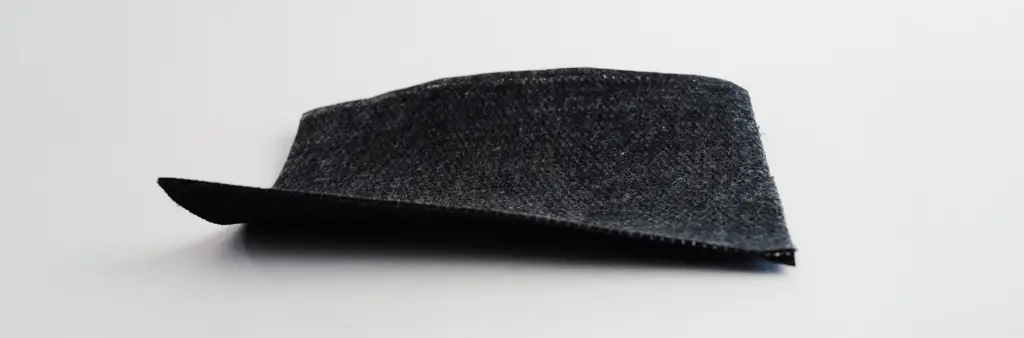
Adjustable parameters for
your cut protection solution.
Four parameters determine how resistant and precisely fitting the component will be – for cut-stressed applications, wire design is key.
Wire diameter & material strength.
High-strength stainless steels with sufficient residual ductility deform under the blade instead of breaking. Since thicker wire reduces mesh density, material and wire gauge are always determined together with the layer structure.
Mesh structure & density.
A denser mesh more tightly encloses the attack path of sharp edges, while a more open structure maintains flexibility. This ratio controls the balance between protective effect and adaptability.
Layers & construction.
Single or multi-layered, with a textile or polymer backing layer if required: The layer configuration determines the protection level and integration into the surrounding component structure.
Geometry & fastening.
Sleeve, edge profile, protective layer, or circumferential reinforcement: Form and fastening depend on installation space and load direction – the knitted mesh is precisely integrated.
These four adjustable parameters create a component that precisely fits your application – not by chance, but by design.
Why eloona?
Because reliable cut protection is no accident.
Designers, plant engineers, and safety officers come to us when standard protection fails against sharp edges, abrasion, or continuous mechanical stress. We develop functional components, not catalog items – every protection solution arises from your specific requirements: type of load, geometry, fastening.
Precise in construction. Clear in function. Strong under load.
Frequently asked questions about cut protection with knitted wire mesh.
How does knitted wire mesh protect against cuts and abrasion?
The metallic mesh structure distributes localized cutting and stabbing loads over many wire loops and provides a resistant, planar structure against abrasive stress. Instead of being severed at one point, the knitted mesh dissipates the force across its surface. We design the wire gauge, material, and mesh size for the respective load.
Is cut-protection mesh certified protective equipment?
No. We supply technical functional components for mechanical cut and edge protection, not certified personal protective equipment (PPE) according to standards like EN 388. Where such requirements apply to your application, we openly clarify the scope – the designer or plant engineer is responsible for the protective effect within the overall system.
Does the knitted mesh also protect against heat or flames?
These are two different tasks. Cut protection addresses mechanical stress from edges and abrasion. Flame-retardant or heat-resistant constructions fall under fire protection – there, fibres and materials can be specifically designed for that purpose. We deliberately keep these two clusters separate so that each component is precisely designed for its task.
What materials is the cut-protection mesh made of?
Common materials are stainless steel and tough special alloys, whose wire gauge and hardness are matched to the cutting and abrasion load. The specific material choice depends on the type of load, environment (e.g., corrosion), and installation situation.
Can the knitted mesh be integrated into existing components?
Yes. The cut-protection mesh can be integrated into a fabric or component structure without adhesives and also into existing systems. As a sleeve, edge profile, protective layer, or circumferential reinforcement, it is precisely fitted into the installation space.
How does the knitted mesh behave under vibration and continuous load?
The metal structure remains dimensionally stable under vibration and recurring movement and retains its protective effect. Unlike soft or textile layers, it does not permanently deform.
Is knitted wire mesh also suitable for vandalism protection?
Yes. In abrasive or deliberately stressed environments – for example, as a cut-resistant insert in seat covers or truck tarpaulins – the metallic structure prevents intentional cutting. The design depends on the expected load and desired flexibility.
How do I find the right cut protection component for my application?
It is best to describe the type of load (cut, abrasion, stab), the component to be protected, the geometry, and the fastening situation. Based on this, we will suggest the material, wire gauge, and construction. A brief inquiry via the contact form is sufficient to get started.
Your cut protection challenge –
let’s discuss it
Whether you are developing a protective component from scratch or seeking a specific solution for a sharp-edged, abrasive, or mechanically stressed component: We design the knitted wire mesh precisely for your load – from the first sketch to the ready-to-install component.
For a quick start, the following information helps us:
- Type of load (cut, abrasion, stab, vandalism)
- the component to be protected and its environment
- geometry and installation space
- fastening situation
- special requirements (corrosion, temperature, flexibility)
So that sharp edges meet resilient structures where it matters.