
Extraction technology &
oil mist separation.
When flow and separation
must work together.
Technical filter, separation, and flow structures for extraction systems, exhaust air systems, and industrial air processes.
We develop knitted mesh and filter structures tailored to the medium, volume flow, and load – from oil mist separation to particle retention, precisely fitting your system.
What knitted wire mesh achieves in extraction technology.
In extraction technology, airflows must be safely guided, media separated, and system components reliably protected. Flow behavior, pressure drop, separation efficiency, and cleanability play a central role in this.
- High separation efficiency – the intricate wire structure reliably captures oil mist, aerosols, and particles from the extraction stream.
- Flow-optimized – the open structure separates without significantly throttling the volume flow – low pressure drop in continuous operation.
- Easy to clean & durable – metallic knitted mesh can be cleaned and reused instead of ending up as disposable filters.
- Robust in industrial use – resistant to oil, heat, and continuous load, even with high throughput.
Applications
- Industrial extraction systems
- Exhaust air systems
- Oil mist and aerosol separation
- Spark and particle retention
- Pre-filters and separation elements
- Special solutions for air guidance
eloona develops knitted mesh and filter structures for extraction systems that are tailored to the medium, volume flow, particle or droplet load, and installation situation. This creates solutions for industrial processes where air must not only be moved but also technically controlled.
Suitable products for extraction and oil mist separation.
Whether it’s oil mist from machining, aerosols from process exhaust, or chips and particles from extraction – the right separation comes from the right component.
Knitted wire mesh
The core material: knitted metal structure made of stainless steel, formable into separation inserts, pre-separators, and filter elements. The basis of every customized extraction solution.
Separation cassettes
For structured oil mist and aerosol separation with defined geometry – robust, easy-to-clean cassettes for extraction systems and exhaust air systems.
Wound filters
Where fine oil mist and aerosols occur at high volume flow, wound filter layers reliably separate – designed for continuous operation and high loading.
How knitted wire mesh separates oil mist and particles.
Separation is achieved not by a dense filter that slows down the volume flow, but by the structure of the knitted mesh. Three mechanisms interact.
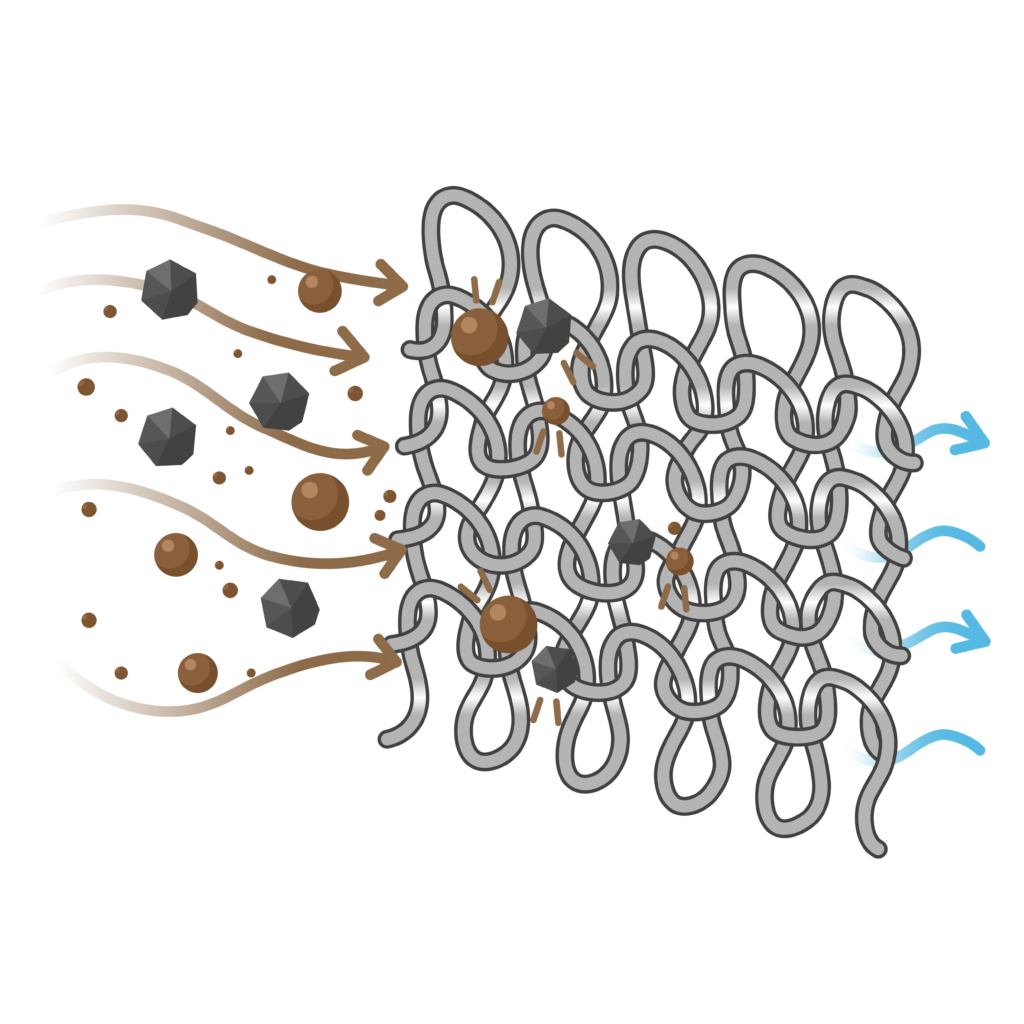
Inertial separation (impaction).
The laden extraction stream is repeatedly redirected within the intricate wire structure. Heavy particles and droplets cannot follow the changes in direction, impact the wires, and are retained – while the cleaned air continues to flow.
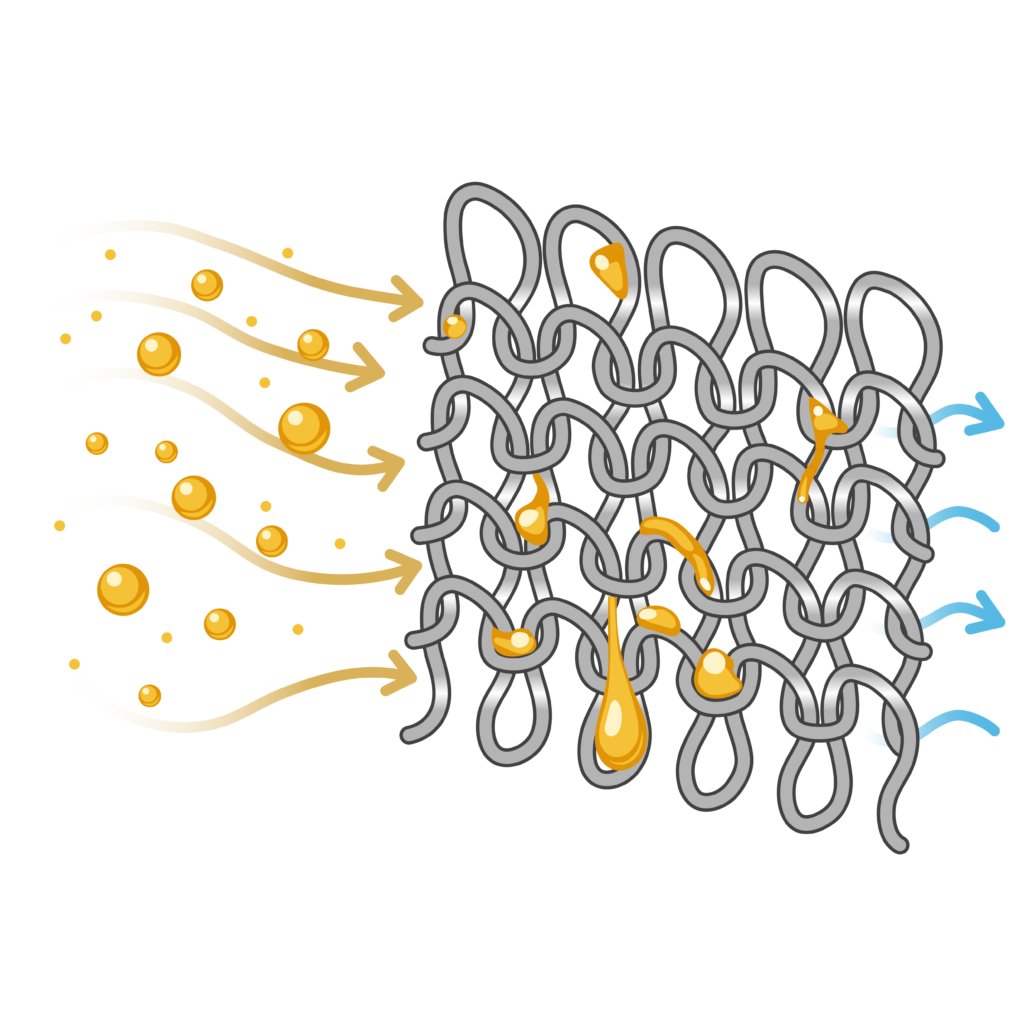
Coalescence of oil mist and aerosols.
On the large internal wire surface, the finest oil and aerosol droplets accumulate and merge into larger drops. These drain off and are collected – thus, even fine oil mist that a coarse filter would let through is separated.
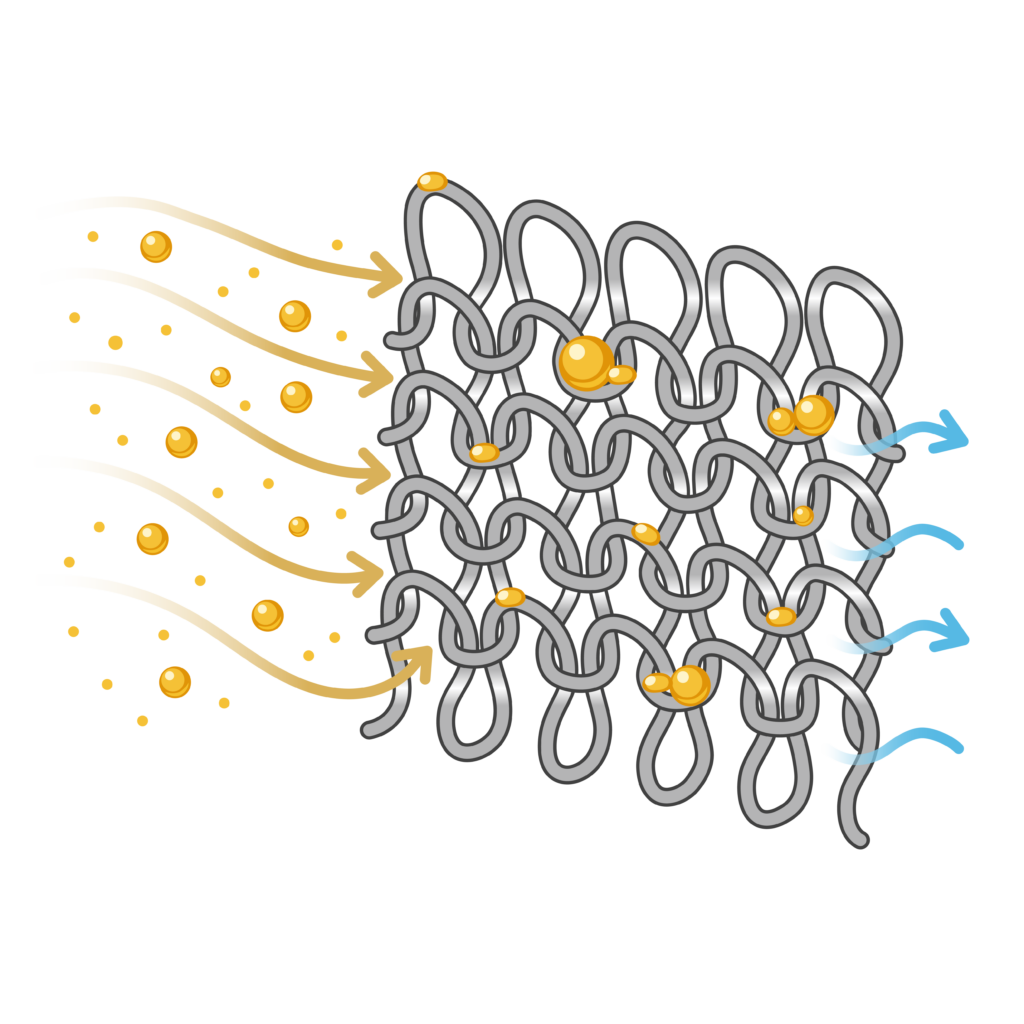
Interception of fine droplets.
Droplets too small for impaction follow the flow around the wire. If their path passes closer than one droplet radius to the surface, they touch the wire and adhere. The finer the wire or fibre, the stronger the effect – over many layers, it has a significant impact and extends separation to smaller droplets.
How finely the knitted mesh separates and how low the pressure drop remains depends on the design – on four adjustable parameters that we tailor to your system.

Adjustable parameters for your separation element.
The function the structure performs results from a few parameters. We design them together with you for the application.
Packing density.
How densely the knitted mesh is packed determines the separation efficiency and pressure drop. Denser means finer separation, more open means higher throughput – we find the balance for your volume flow.
Wire gauge & mesh size.
Finer wires capture smaller aerosols and oil mist droplets, coarser ones are more robust against chips and coarse particles. The combination controls what load the element safely handles.
Material & resistance.
Stainless steel for oil, heat, and corrosion resistance in continuous operation; special materials for aggressive media or high temperatures if required.
Design & integration.
Insert, cassette, or pre-separator: shape and format depend on the system, volume flow, and installation situation – the element integrates into the extraction system, not the other way around.
These four adjustable parameters create a component that precisely fits your system – not by chance, but by design.
Why eloona?
Because good separation is no accident.
Plant engineers, operations managers, and designers come to us when a separation element needs to simultaneously separate finely, allow high volume flow, and withstand continuous operation. We develop custom filter components, not catalog items – tailored to the medium, volume flow, and installation space of your extraction system.
Precise in separation efficiency. Clear in throughput. Strong in continuous operation.
Frequently asked questions about extraction technology and oil mist separation with knitted wire mesh.
How does a knitted wire mesh element separate oil mist and particles from the extraction air?
The laden extraction stream is redirected multiple times within the intricate wire structure. Heavy particles impact the wires and are retained, while fine oil mist accumulates on the large surface and coalesces into draining droplets. The cleaned air continues to flow with low pressure drop.
Is knitted wire mesh suitable as an oil mist separator?
Yes. Through coalescence – the merging of the finest oil droplets on the wire surface – the knitted mesh also separates fine oil mist, such as that generated during machining, on CNC machines, or in process exhaust. The design depends on the amount of oil mist, volume flow, and required separation efficiency.
Can the knitted mesh also retain chips and grinding dust from extraction?
Yes. With coarser meshes and robust wire gauges, the knitted mesh also retains metal chips, coarse grinding dust, and larger particles – often as a pre-separator before a finer filter stage. This relieves the downstream filter technology.
Can the separation element be cleaned?
Yes. Metallic knitted mesh elements are designed for repeated cleaning and maintain their function over many cycles. Unlike disposable filters or filter bags, this reduces follow-up costs and waste during operation.
Can knitted wire mesh retain sparks and glowing particles?
Does the knitted mesh slow down the volume flow?
Usually only slightly. The open structure separates without significantly narrowing the airflow path – the pressure drop remains low, which is particularly important for high extraction capacities in continuous operation. We balance separation efficiency and pressure drop through the packing density.
How resistant is the knitted mesh to oil, heat, and continuous load?
Stainless steel is oil, corrosion, and temperature resistant and designed for continuous industrial use. Special materials are possible for aggressive media or high temperatures – the choice depends on the process and environment.
How do I find the right separation element for my extraction system?
It is best to describe the medium, volume flow, load (oil mist, aerosols, chips), and the installation situation. Based on this, we will suggest the packing density, wire gauge, and design. A brief inquiry via the contact form is sufficient to get started.
Do you want to optimize your extraction technology?
Talk to us.
Whether you are designing a new extraction system and planning separation from scratch, or looking for a precisely fitting separation element for an existing system: We develop the component exactly to the medium, volume flow, and separation efficiency – from the first sketch to the ready-to-install element.
For a quick start, the following information helps us:
- media to be separated (oil mist, aerosols, chips, dust)
- volume flow and operating conditions
- required separation efficiency
- permissible pressure drop
- system, installation space, and installation situation
So that flow and separation work together – at any volume flow.