
Insulation.
When components need to be thermally,
mechanically, or
acoustically
decoupled.
Individual knitted mesh and special structures for thermal, mechanical, or acoustic decoupling.
eloona develops technical structures that specifically decouple heat, vibration, or sound – as functional components designed for your application. Where certified insulation values or protection classes are required, we clarify the framework together with you.
What knitted wire mesh achieves for insulation.
Insulation can fulfill many functions: reducing heat, decoupling components, influencing sound, or absorbing mechanical loads. eloona develops technical structures that insulate, protect, or separate depending on the application.
- Thermally effective – the metallic structure reduces heat transfer and shields temperature-sensitive components.
- Mechanically decoupling – elastic compliance absorbs vibrations and shocks and vibrationally separates components.
- Acoustically damping – the open knitted mesh structure breaks and dampens structure-borne and airborne sound.
- Adaptable – material, wire gauge, and structure are designed for the respective decoupling task.
Applications
- Thermal insulation
- Mechanical decoupling
- Acoustic damping
- High-temperature areas
- Machinery and plant engineering
- Mufflers
- Special components with multiple functions
By selecting suitable material and structural parameters, knitted wire meshes and material combinations can be precisely tuned to temperature, medium, installation space, and stress. This creates durable solutions for demanding industrial applications – often with multiple decoupling functions in one component.
Suitable products for insulation and decoupling tasks.
Whether thermal shielding, mechanical decoupling, or acoustic damping – the right solution arises from the correct material and its processing. These products form the basis.
Knitted wire meshes
The material core: knitted metal structure made of stainless steel or high-temperature alloys, formable into damping elements, shields, and decoupling layers. The basis of every thermal, mechanical, or acoustic functional component.Special components with multiple functions
Decoupling elements, heat shields, and combined damping components are developed as engineering services – designed for temperature, frequency, installation space, and fastening. Often, one component combines several decoupling functions.
How knitted wire mesh decouples and insulates.
The protective effect does not come from material thickness, but from the structure of the knitted mesh. Three mechanisms interlock.
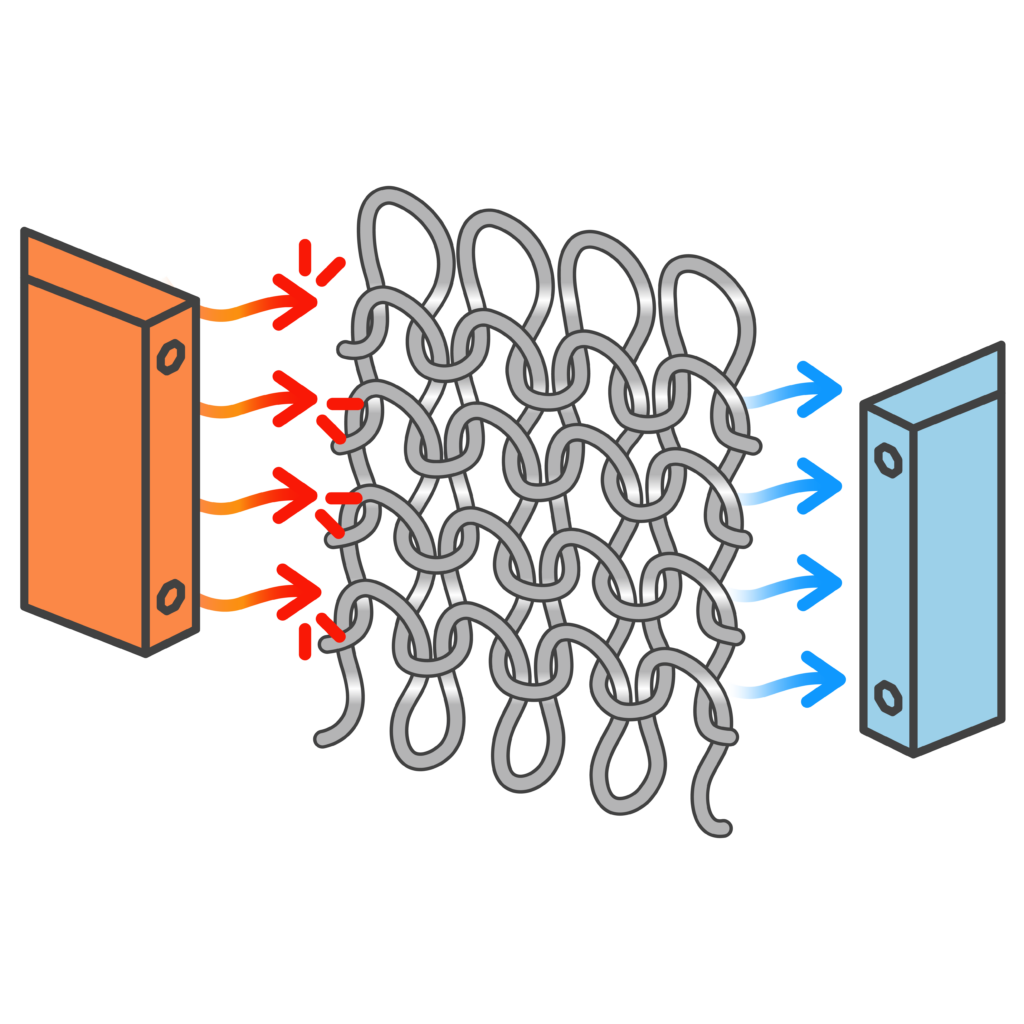
Thermal decoupling.
The open mesh structure creates many small contact points instead of a continuous material bridge. This hinders direct heat conduction between the hot and cold sides – the knitted mesh acts as a mechanically resilient separating layer that minimizes thermal bridges and shields radiation.
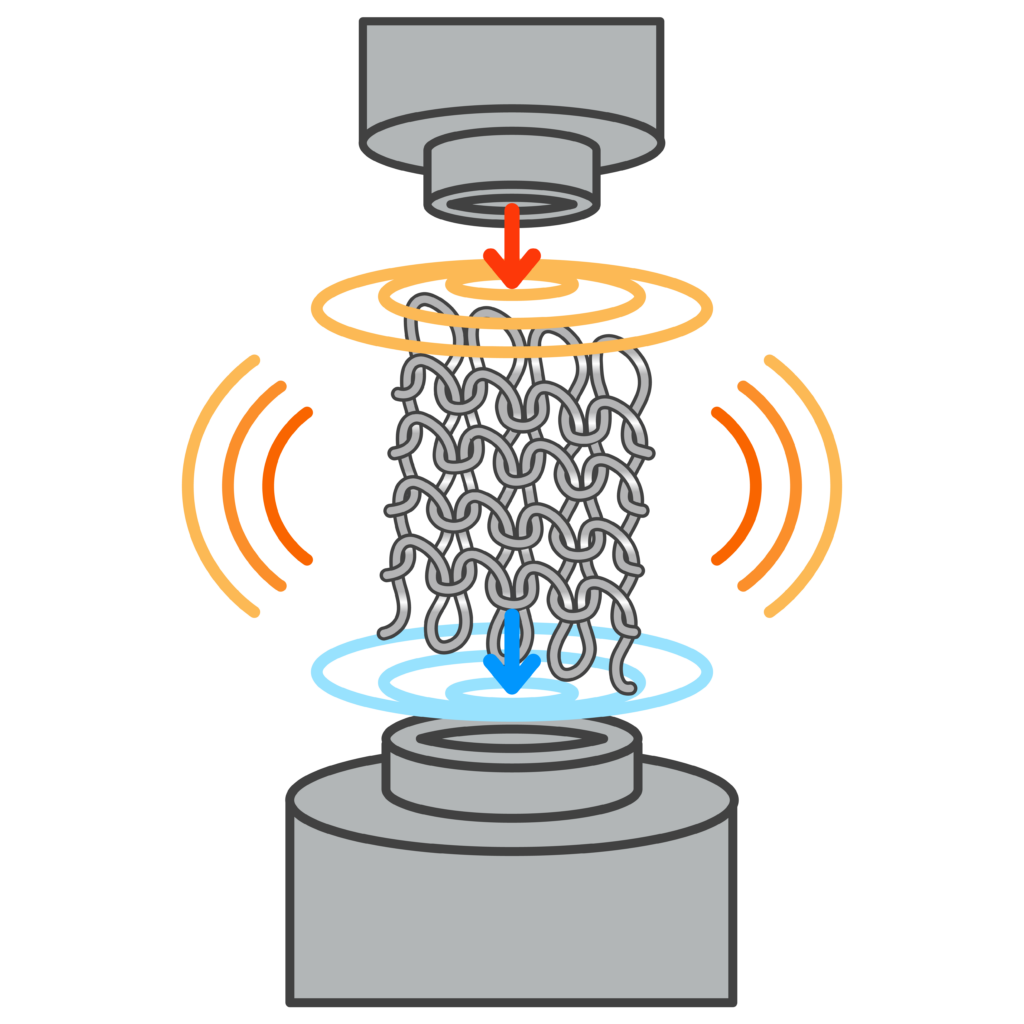
Mechanical decoupling.
The elastic compliance of the knitted wire mesh absorbs vibrations and shocks and transmits them only in a damped manner. Unlike a rigid component, the knitted mesh separates the vibration source and its environment – without permanent deformation.
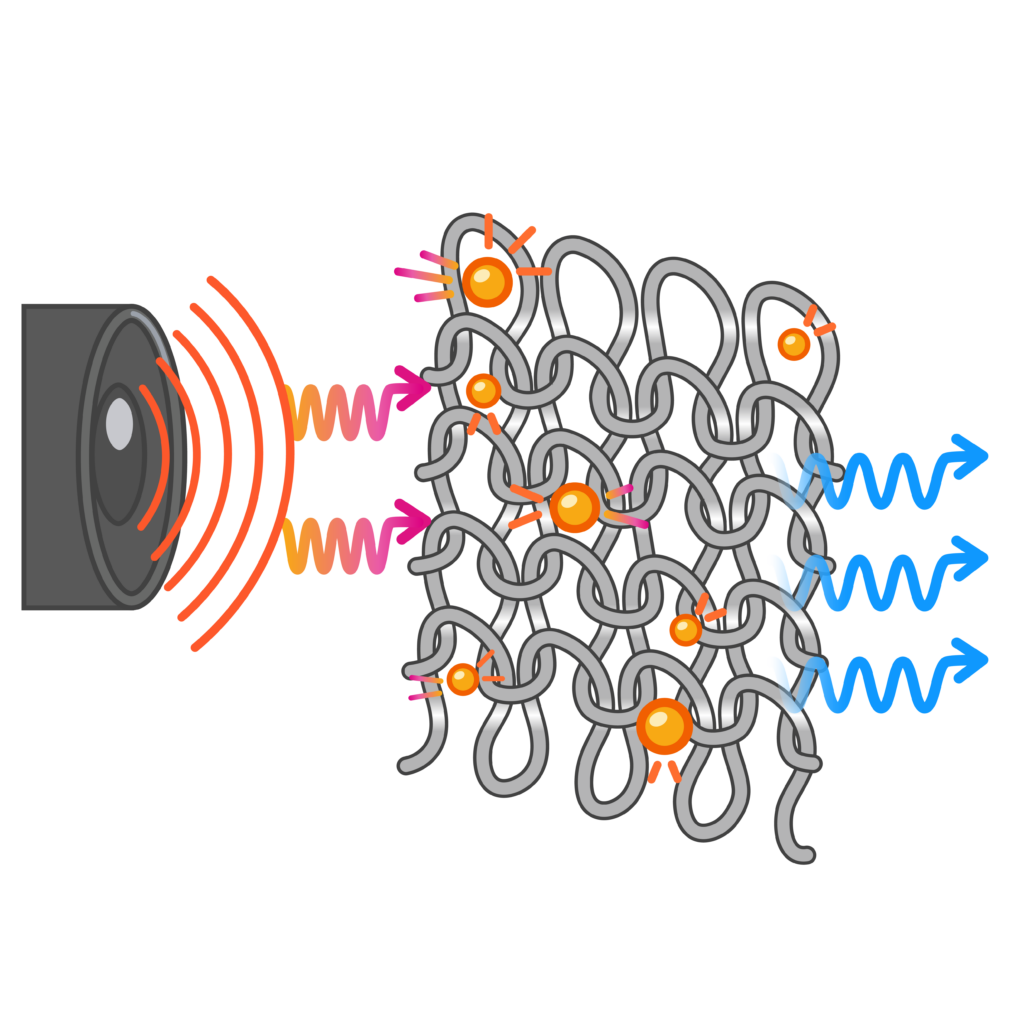
Acoustic damping.
Structure-borne and airborne sound are broken by the intricately intertwined wire structure and converted into frictional heat. The open structure dampens sound over a broad frequency range instead of merely reflecting it.
How strongly each of these methods works depends on the design – on four adjustable parameters that we tailor to your application.
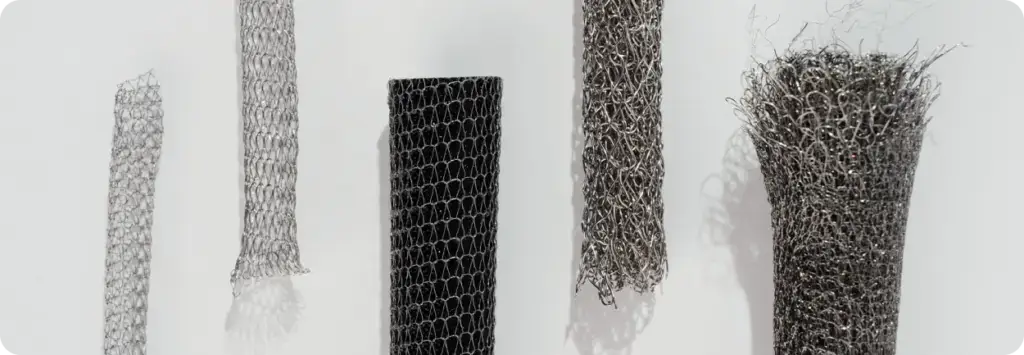
Adjustable parameters for
your insulation solution.
Four parameters determine which function the component fulfills and to what extent – thermal, mechanical, or acoustic. We tailor them to your application.
Packing density.
How densely the knitted mesh is compressed determines the thermal separation effect, vibration absorption, and acoustic damping. Density is the central lever for the strength of the decoupling.
Material selection.
Stainless steel, high-temperature alloys, or special materials – the wire alloy determines the upper temperature limit, corrosion behavior, and damping capacity. It is the first variable to be clarified.
Wire gauge & mesh structure.
Finer or coarser wires and meshes control the balance between stiffness and compliance – and thus whether the component primarily shields, dampens, or springs.
Geometry & construction.
Element, sleeve, mat, or multi-layer composite: shape and layer structure depend on installation space, fastening, and the desired functional combination – one component can perform several decoupling tasks.
From these four adjustable parameters, a component is created that precisely fits your application – not by chance, but by design.
Why eloona?
Because reliable decoupling and insulation are not a matter of chance.
Designers and developers come to us when a component needs to simultaneously shield heat, absorb vibrations, or dampen sound – and standard solutions fail due to these multiple requirements. We develop functional components, not catalog items: every decoupling solution arises from your specific requirements – temperature, frequency, installation space.
Precise in construction. Clear in function. Strong in separation.
Frequently asked questions about insulation and decoupling with knitted wire mesh.
What decoupling tasks does knitted wire mesh perform?
Knitted wire mesh decouples in three ways: thermally (limiting heat transfer, minimizing thermal bridges), mechanically (absorbing and damping vibrations and shocks), and acoustically (reducing structure-borne noise). Often, a single component performs several of these functions simultaneously. We design the material, wire gauge, and packing density for the respective task.
Is knitted wire mesh a certified insulation material?
No. We supply technical functional components for thermal, mechanical, and acoustic decoupling, not building-code certified insulation systems or tested soundproofing components. Where standard values or protection classes are required, we openly clarify the framework and supply the component to match your overall concept.
When do I need decoupling, and when do I need targeted vibration damping?
The transitions are fluid – insulation and damping are two mechanisms of the same task. This page addresses decoupling in a broader sense: thermal, mechanical, and acoustic, often combined in one component. If exclusively vibration behavior is in focus – natural frequency, transmissibility, design for a defined frequency range – you will find a more in-depth discussion on our vibration damping page.
What temperatures can the knitted mesh withstand?
That depends on the material. Stainless steel knitted meshes can be used across wide ranges of high temperatures; high-temperature alloys extend beyond that. We jointly determine the permissible range for your application based on the material and construction.
Is knitted wire mesh suitable for sound damping?
Yes. The open, intricately intertwined wire structure breaks structure-borne and airborne sound and converts vibrational energy into friction. In mufflers and acoustically stressed components, the knitted mesh dampens over a broad frequency range – the specific design depends on the frequency and installation situation.
Can one component perform multiple decoupling functions?
Yes – that is precisely its strength. Through material, structure, and packing density, thermal, mechanical, and acoustic effects can be combined in one component. Thus, a well-designed knitted mesh component often replaces several individual solutions.
How is a knitted wire mesh decoupling element installed?
As an element, sleeve, mat, or multi-layer composite, the knitted mesh is precisely fitted into the installation space – between the vibration source and the environment, at the thermal bridge, or in the muffler. We tailor the shape and fastening to your installation situation.
How do I find the right insulation component for my application?
The best way is to describe the task to us: Should the component decouple heat, vibration, or sound – or several at once? With information on temperature, frequency, installation space, and fastening, we will propose the material, structure, and construction. A brief inquiry via the contact form is sufficient to get started.
Do you need to get heat, vibration, or sound under control? Then let’s talk about it!
Whether you are developing a component from scratch that must control heat, vibration, and sound simultaneously, or you are looking for a specific decoupling solution for a single task: We design the knitted wire mesh precisely for it – from the initial idea to the ready-to-install component.
For a quick start, the following information helps us:
- which function is paramount (thermal, mechanical, acoustic – or combined)
- temperature and frequency range
- the affected component and its environment
- geometry and installation space
- fastening situation
So that heat, vibration, and sound stay where they belong – and not where they cause disturbance.