
Filtration.
When standard solutions reach
their limits.
Filtration for demanding applications is rarely a purely standard task. Medium, particle size, droplet spectrum, flow velocity, temperature, pressure drop, and cleanability determine which structure actually works.
Using technical knitted wire mesh, we develop filter and separation solutions that are precisely tailored to the respective application – from coarse separation to fine droplet separation.
What knitted wire mesh achieves in filtration.
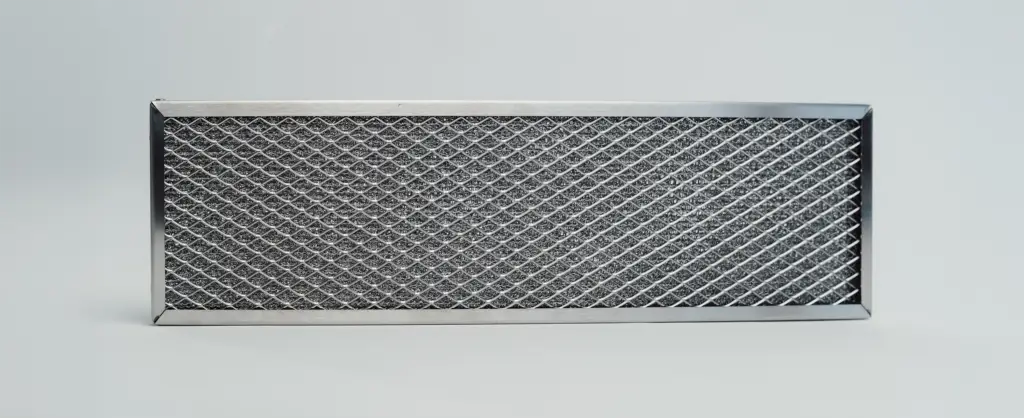
Knitted wire meshes are not standard filters. They are a flexibly designable filter structure that, depending on the task, separates, removes, calms, or captures – with a large surface area and a comparatively low pressure drop.
For every filtration task, we combine the right material with the right geometry: knitted meshes made of stainless steel, special metals, plastics, fibre yarns, or material combinations – each configured so that the filter performance works in real operation and not just on paper.
This results in filter and separation structures that are exactly matched to the application – from coarse separation to fine droplet separation.
Areas of application
- Droplet separation
- Oil mist separation
- Gas and liquid filtration
- Process air and exhaust air
- Apparatus and plant engineering
- Wound filters, separation cassettes, and special filters
Suitable products
for your filtration task.
Depending on the application, different knitted wire mesh solutions are used – from the filter medium in its raw state to the ready-to-install component:
Knitted wire meshes
In over 40 materials and individual geometries
Separation cassettes
Ready-to-install filter cassettes for flow-guided systems
Wound filters
Compact filter solutions for droplet and aerosol separation
Key parameters for
filtration performance.
The filter performance of a knitted wire mesh is not determined by a single characteristic, but by the interaction of several parameters. We design the filter structure for your application using these four key parameters:
Mesh size.
Determines which particles and droplets are mechanically retained. Narrower meshes increase the separation efficiency but can increase the pressure drop.
Wire diameter.
Influences surface area, mechanical stability, and flow behavior. Fine wires increase the effective surface area; thicker wires increase service life and load capacity.
Packing density.
Determines how tightly the knitted wire mesh is compressed. Higher density improves separation efficiency but affects pressure drop, cleanability, and service life.
Material choice.
Stainless steel, special metals (Inconel®, Monel®, Hastelloy®, titanium, duplex), plastics, fibre yarns, or material combinations – depending on the medium, temperature, and chemical load.
From these four key parameters, a filter structure is created that fits your application exactly –
not by chance, but by design.
Why eloona?
Because good filtration is no coincidence.
It is the result of technical understanding, clean manufacturing, and genuine cooperation. We listen carefully, immerse ourselves in applications, and develop filter structures that are not only right on paper but also convincing in real operation. Precise in detail. Clear in function. Strong in effect.
This is how solutions are created that do not push themselves into the foreground – but make the difference exactly where it matters.
Frequently asked questions about filtration with knitted wire mesh.
How does filtration with knitted wire mesh work?
Knitted wire meshes filter via three combined mechanisms: inertial separation, diffusion separation, and the barrier effect. Larger particles do not follow the flow and collide with the wires, very small particles get caught due to their own movement, and everything larger than the mesh size is mechanically retained. Which mechanism dominates depends on the application – we design the structure accordingly.
What particle sizes can a knitted wire mesh filter separate?
That depends on the mesh size, wire diameter, and packing density. Knitted wire meshes cover a wide range – from the coarse separation of larger droplets and particles to fine aerosol separation. We develop the appropriate knitted mesh structure for each specific particle size.
How high is the pressure drop in a knitted wire mesh filter?
The pressure drop depends directly on the mesh size, packing density, and flow velocity. Knitted wire meshes generally offer a comparatively low pressure drop with high separation efficiency. In a specific design discussion, we specifically coordinate filter performance and pressure drop with each other.
Can knitted wire mesh filters be cleaned and reused?
In many cases, yes. Knitted wire meshes made of metal are robust and, depending on the material and contamination, can be cleaned multiple times – by rinsing, burning out, or mechanical cleaning. We already take cleaning and maintenance into account during the design phase through the choice of material and the geometry of the filter structure.
Which materials are suitable for filtration with knitted wire mesh?
We process stainless steels, special metals such as Inconel®, Monel®, Hastelloy®, and titanium, as well as plastics, fibre yarns, and combined materials. The choice of material depends on the medium, temperature, chemical load, and mechanical requirements. For extreme conditions, we specifically match the material to the application.
For which media are knitted wire mesh filters suitable?
Knitted wire meshes filter gases, air, steam, and liquids – even under aggressive conditions such as high temperatures, corrosive media, or chemically contaminated atmospheres. The design of the filter always follows the specific medium and process conditions.
How does knitted wire mesh differ from woven wire in filtration?
Woven wire consists of wires woven at right angles with a fixed mesh size. Knitted wire mesh is knitted from continuous loops – this makes it more elastic, more compressible, and gives it a significantly larger effective surface area per volume. For droplet separation and fine filtration, knitted mesh is therefore usually the functionally better choice.
How do I find the right knitted wire mesh filter for my application?
The best way is to describe your application to us: medium, volume flow, temperature, particle size, and installation situation. On this basis, we will work together to develop the right filter structure – from the initial design to the ready-to-use solution.
Let’s talk about
your filtration task.
Do you have a specific filtration task – or a still unclear problem with flow, pressure drop, or service life? Describe your application to us, and we will work together to develop the appropriate knitted wire mesh filter structure.