
Vibration damping.
When rubber reaches its
limits.
Where elastic materials such as rubber or elastomers fail due to temperature, media resistance, or long-term stability, metallic knitted wire meshes can be an effective alternative. Their three-dimensional, resilient structure is suitable for applications where vibrations must be reduced, movements absorbed, or components mechanically decoupled.
We develop damping solutions based on installation space, load case, temperature range, medium, and desired damping behavior – even where standard materials no longer function.
What knitted wire mesh achieves in vibration damping.
Knitted wire meshes are three-dimensional structures made of finely knitted metal wires. Under load, the wire layers are pressed against each other – friction between the wires and elastic deformation convert kinetic energy into heat. This results in damping that functions mechanically and does not require an elastic polymer matrix.
This is precisely where the decisive difference to rubber and other elastomers lies. Where polymers harden under temperature, are attacked by oils and solvents, or become brittle over the years, a metallic knitted wire mesh structure remains dimensionally stable and functional – even at high temperatures, in aggressive media, and over long periods of use.
Areas of application
- Machine and plant engineering
- Automotive engineering
- Housing and unit mounting
- Technical decoupling
- High-temperature applications
- Special dampers and insert elements
We use this to develop custom-made damping elements – as robust metallic functional components for vibration, shock loads, movement, and thermal stress. We can specifically tune the damping behavior to the application via wire diameter, material, density, and component geometry.
Suitable products
for your damping task.
Depending on the application and requirements, different knitted wire mesh structures are used – from the base material to project-specifically developed functional components:
Knitted wire meshes
The base material, in stainless steels and special metals for temperature- and media-resistant damping elements.
Structures
Specifically tuned mesh, wire, and compression structures for defined damping, spring, and reset properties.
Custom-made molded parts
Molded parts adapted to installation space, load direction, and installation situation for reliable vibration decoupling.
One material,
many designs.
In vibration damping, knitted wire mesh is almost always used as an individually designed component – as a bushing, ring, cylinder, pad, or special geometric shape. We develop and manufacture damping components suitable for your installation space and load case.
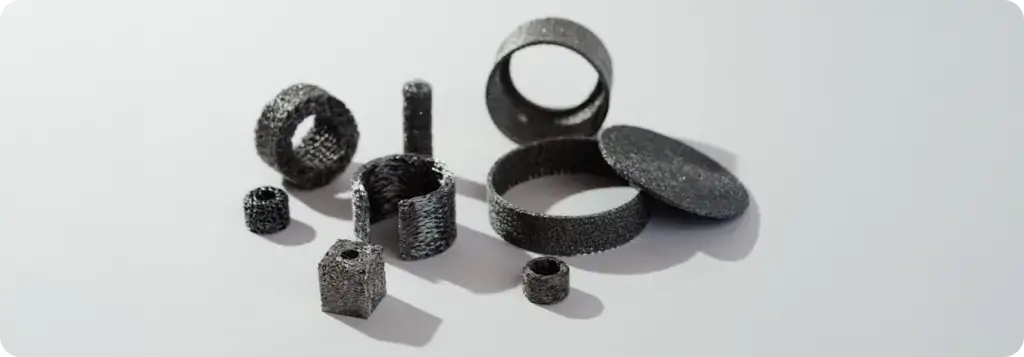
How knitted wire mesh damps vibrations.
A knitted wire mesh pressed part provides both spring and damping – via two mechanisms that arise from the same structure.

Internal friction between the wire layers.
Under load, the finely knitted metal wires shift against each other. The friction between the wire contact points converts part of the kinetic energy into heat – this is the main damping effect that technically distinguishes knitted wire mesh from elastomers, where damping occurs via internal material deformation (hysteresis).

Elastic deformation of the structure.
The three-dimensional wire arrangement can be elastically compressed and returns to its original shape after unloading. This elastic component enables defined spring travel without the material being permanently deformed.

Energy conversion via the internal surface area.
The large internal surface area of a knitted wire mesh distributes introduced energy across a multitude of contact points. In this way, even pulse-like shock loads can be absorbed and uniformly converted into heat.
Unlike polymers, this damping effect remains stable over a wide temperature range and in chemically aggressive media – because it does not depend on the nature of an elastic matrix, but on the mechanical interaction of the metallic structures.
Key parameters for
the damping function.
How a knitted wire mesh component damps and springs does not depend on a single feature, but on the interaction of several parameters. We design the component for your application using these four key parameters:
Mesh structure.
Determines how the wire layers slide against each other under load. Mesh shape and mesh size determine how much kinetic energy is dissipated through friction and how soft or firm the element’s spring action is.
Wire diameter.
Influences stiffness, load-bearing capacity, and service life. Fine wires result in soft, finely responsive damping behavior; thicker wires increase load capacity and service life under high loads.
Packing density.
Determines how much the knitted wire mesh is compressed. A higher density increases stiffness and load-bearing capacity, while a lower density provides more spring travel and a softer response.
Material choice.
Stainless steel, special metals (Inconel®, Monel®, Hastelloy®, titanium, duplex), plastics, fibre yarns, or material combinations – depending on the medium, temperature, and chemical stress.
These four key parameters result in a damping component that fits your application exactly – not by chance, but by design.
Why eloona?
Because good vibration damping is no coincidence.
It is the result of technical understanding, clean manufacturing, and genuine cooperation. We listen carefully, think our way into applications, and develop damping elements that are not only right on paper but also convincing in real operation. Precise in detail. Clear in function. Strong in effect.
This is how solutions are created that do not push themselves to the fore – but make the difference exactly where it matters.
Frequently asked questions about vibration damping with knitted wire mesh.
When is knitted wire mesh the better choice than rubber or elastomers?
Knitted wire mesh shows its strengths wherever elastic materials reach their limits: at high temperatures, in contact with oils, solvents, or aggressive media, and when long-term stability over many years is required. While rubber hardens, becomes brittle, or is chemically attacked under such conditions, a metallic knitted wire mesh structure remains dimensionally stable and retains its damping properties.
How does damping with knitted wire mesh work physically?
Damping is based on internal friction between the finely knitted metal wires. Under load, the wire layers shift against each other, convert kinetic energy via frictional heat, and return to their original shape after unloading. Unlike elastomers, which damp via hysteresis in the material, this mechanical friction is largely independent of temperature and aging.
Is knitted wire mesh an active or passive vibration damping solution?
Knitted wire mesh is a passive damping solution. It requires no control, no sensor, and no external energy – the damping effect arises purely from the mechanical properties of the structure. This makes knitted wire mesh low-maintenance, durable, and particularly suitable for applications where active systems are too complex, too expensive, or simply not practical.
Is knitted wire mesh suitable for high-temperature applications such as transformers?
Yes. In high-temperature environments, knitted wire mesh is one of the few suitable damping solutions because metallic structures retain their mechanical properties even at very high temperatures. Typical areas of application are transformers, engine components, exhaust systems, and industrial plants with thermal stress. Materials such as Inconel®, Hastelloy®, or high-alloy stainless steels significantly extend the usable temperature range.
Can knitted wire mesh also be used to decouple machine feet and machine foundations?
Yes. Knitted wire mesh pads and plates are used to mechanically decouple machines, units, and plants from the ground. They damp vibrations, reduce the transmission of oscillations to the environment, and are resilient enough for high static loads – even over long periods of use without settling behavior or aging.
Which materials are used for knitted wire mesh dampers?
Stainless steels such as 1.4301 and 1.4404 are used as standard. For higher temperatures, aggressive media, or specific chemical requirements, we process special metals such as Inconel®, Monel®, Hastelloy®, titanium, and duplex materials. The choice of material depends on the temperature, medium, and the required long-term stability.
In which designs are knitted wire mesh dampers manufactured?
Knitted wire mesh dampers are created in a wide variety of designs – as bushings, rings, cylinders, pads, plates, sleeves, or special geometric shapes. The design is engineered according to the installation situation, load case, and desired damping direction. Standardized components are possible, but the actual added value lies in the project-specific design.
How do I find the right knitted wire mesh damper for my application?
Describe your application to us: installation space, load case, temperature range, medium, and the desired damping behavior. On this basis, we will work with you to develop the right component – from the initial design to prototypes and series solutions.
Let’s talk about your load case.
Are you developing a component that needs to absorb vibrations or shocks – or is your elastomer solution reaching its limits in terms of temperature, media, or service life? Briefly describe your application to us. Helpful, but not a requirement: installation space, load case, temperature range, medium, and desired damping behavior. We will clarify much of this together anyway – get in touch even if you are just at the beginning. Your inquiry will go directly to a technical contact person, not to a sales distribution list. You will receive an initial technical assessment: whether knitted wire mesh is the right principle for your case – and if not, we will tell you that as well.