
Fire protection.
When materials must withstand
extreme heat.
Fire protection requires materials that remain reliable even under extreme conditions. Metallic knitted wire mesh structures offer particular advantages here: they are temperature-resistant, formable, air-permeable and—depending on the design—can absorb energy, influence flames, or retain sparks.
eloona develops knitted wire mesh components as part of technical fire protection concepts. Certification of the overall system is carried out by the plant engineer or fire protection planner in accordance with the applicable standards.
What knitted wire mesh achieves in fire protection.
Knitted wire meshes are used in fire protection where standard materials are insufficient or where a specific combination of protective effect, permeability, and installation space adaptation is required. Their advantages lie in the choice of material and the structure:
- Temperature-resistant – metallic structures retain their shape and mechanical properties even at very high temperatures, far above the failure range of polymers or classic insulation materials.
- Formable – knitted wire meshes can be shaped into almost any geometry and adapt to tight installation spaces, curved surfaces, or specific installation situations.
- Air-permeable – the open structure allows for controlled airflow without completely negating the function of a thermal barrier.
- Energy-absorbing – depending on the design, knitted wire meshes can absorb thermal energy, delay flame spread, or retain embers and sparks.
Areas of application
- Spark retention
- Heat protection
- Technical protective layers
- Plant and equipment protection
- Exhaust and extraction systems
- Special components in high-temperature areas
Knitted wire mesh is often particularly effective in fire protection when combined with flame-retardant fibres. The metallic structure provides mechanical stability and thermal resistance, while the fibres complement the protective effect in the low-temperature range and reduce smoke development. This creates hybrid protective structures that can cover multiple load cases simultaneously.
Suitable products for your fire protection application.
Depending on the application and protection requirements, different knitted wire mesh structures are used—from the base material to project-specifically developed protective components:
Knitted wire meshes
Metallic knitted mesh structures as a basis for individually designed fire protection and protective components—tailored to installation space, thermal load, and application.
Integrated flame retardancy
Flame-retardant fibres can be integrated directly into the knitted wire mesh. This creates a dimensionally stable composite component without additional adhesives, which could increase smoke and pollutant development in the event of a fire.
Spark and ember retention
The three-dimensional knitted mesh structure can slow down and retain sparks and hot embers. This reduces the risk of ignition in downstream areas and further fire spread.
How knitted wire mesh works in fire protection.
The effect of knitted wire mesh in fire protection is based on three physical effects, which are combined differently depending on the application:
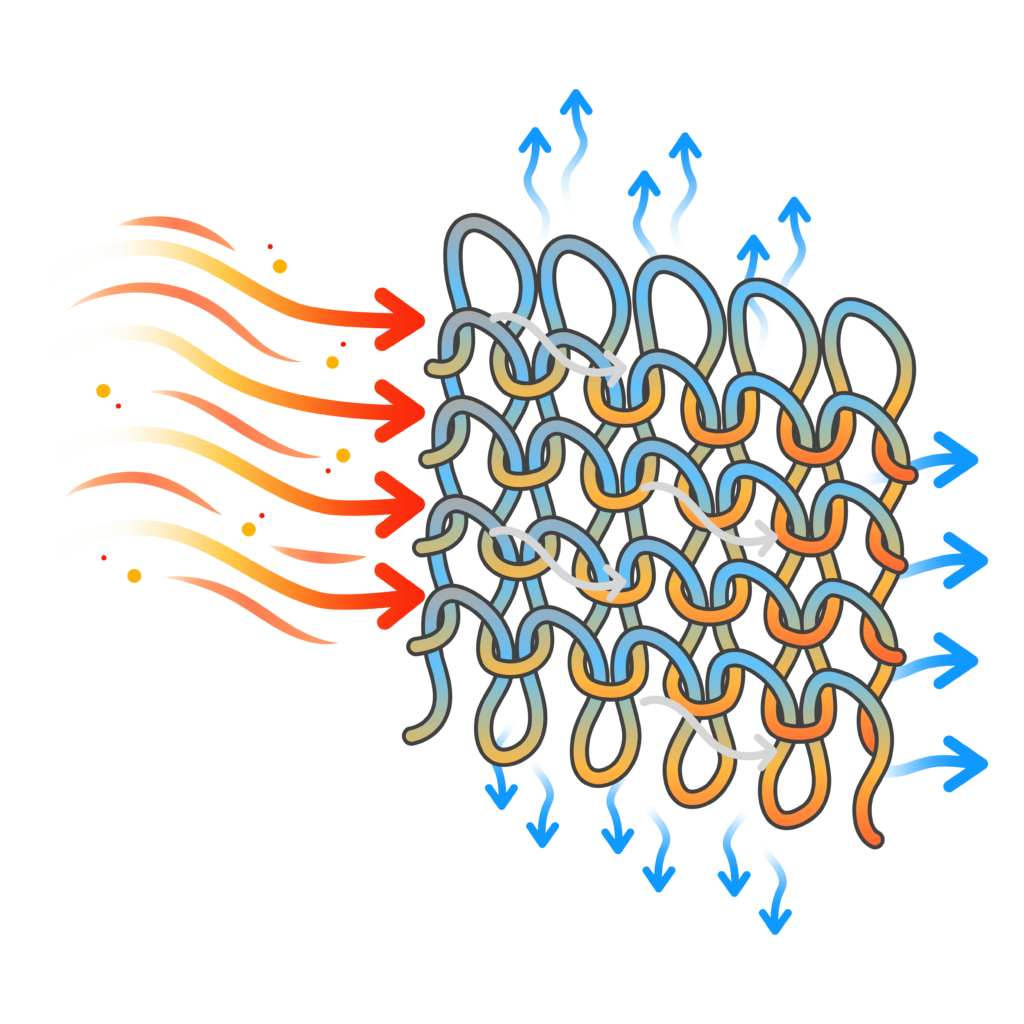
Heat dissipation and cooling at the metallic structure.
The numerous fine metal wires form a large effective surface area. When hot gases, sparks, or embers hit the knitted mesh, part of their heat is absorbed by the wires and distributed within the metallic structure. Depending on the component design and installation situation, the heat can then be released to the environment or adjacent components. This allows local temperature peaks to be reduced and the heat input into downstream areas to be delayed. The extent of this effect is determined, among other things, by the material used, the wire diameter, the knitted mesh density, and the component depth.
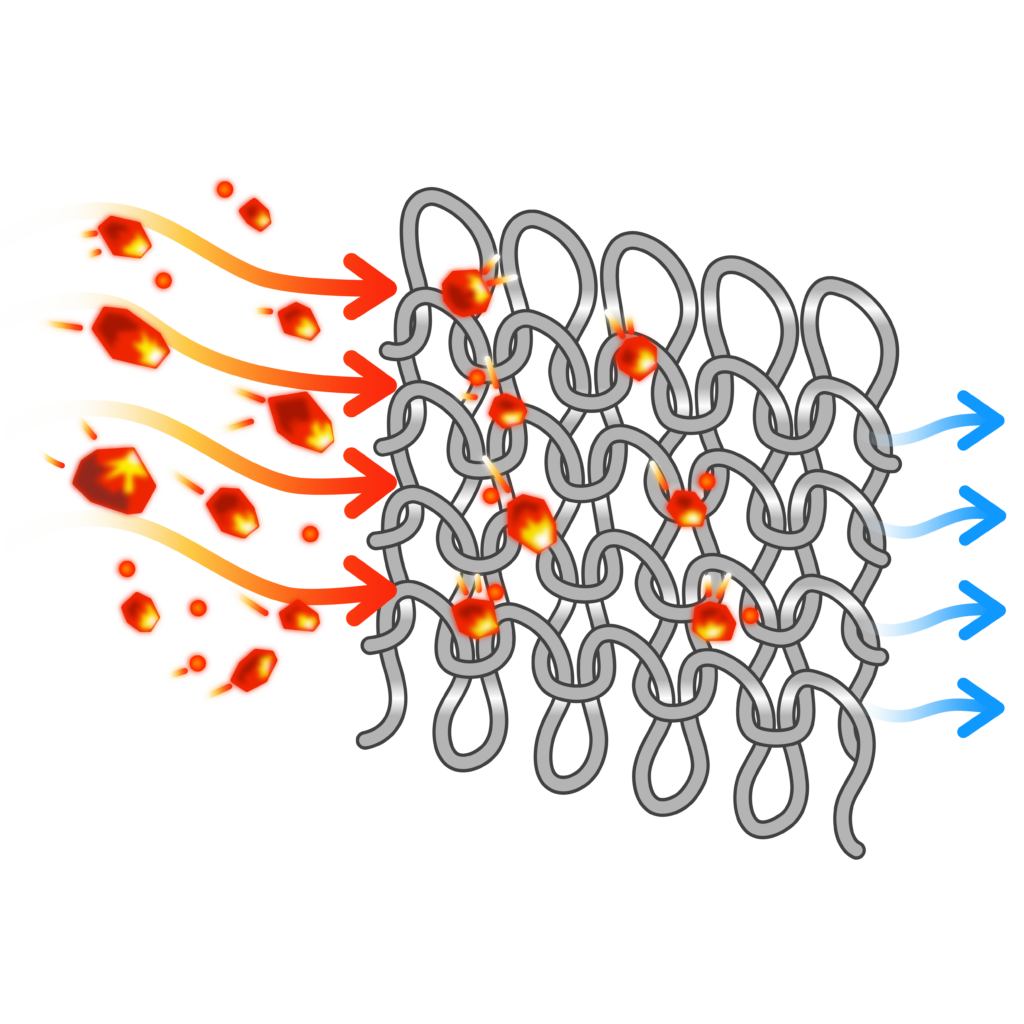
Mechanical barrier effect against embers and sparks.
The three-dimensional knitted mesh structure creates a tortuous flow path for entrained particles. Sparks and embers are diverted, slowed down, and repeatedly hit the metal wires. In the process, they can transfer heat to the metallic structure and be retained within the component. The effectiveness depends, among other things, on the size and temperature of the particles, the flow velocity, the free cross-section, and the compression of the knitted mesh. The component is therefore specifically matched to the respective application and the expected load.
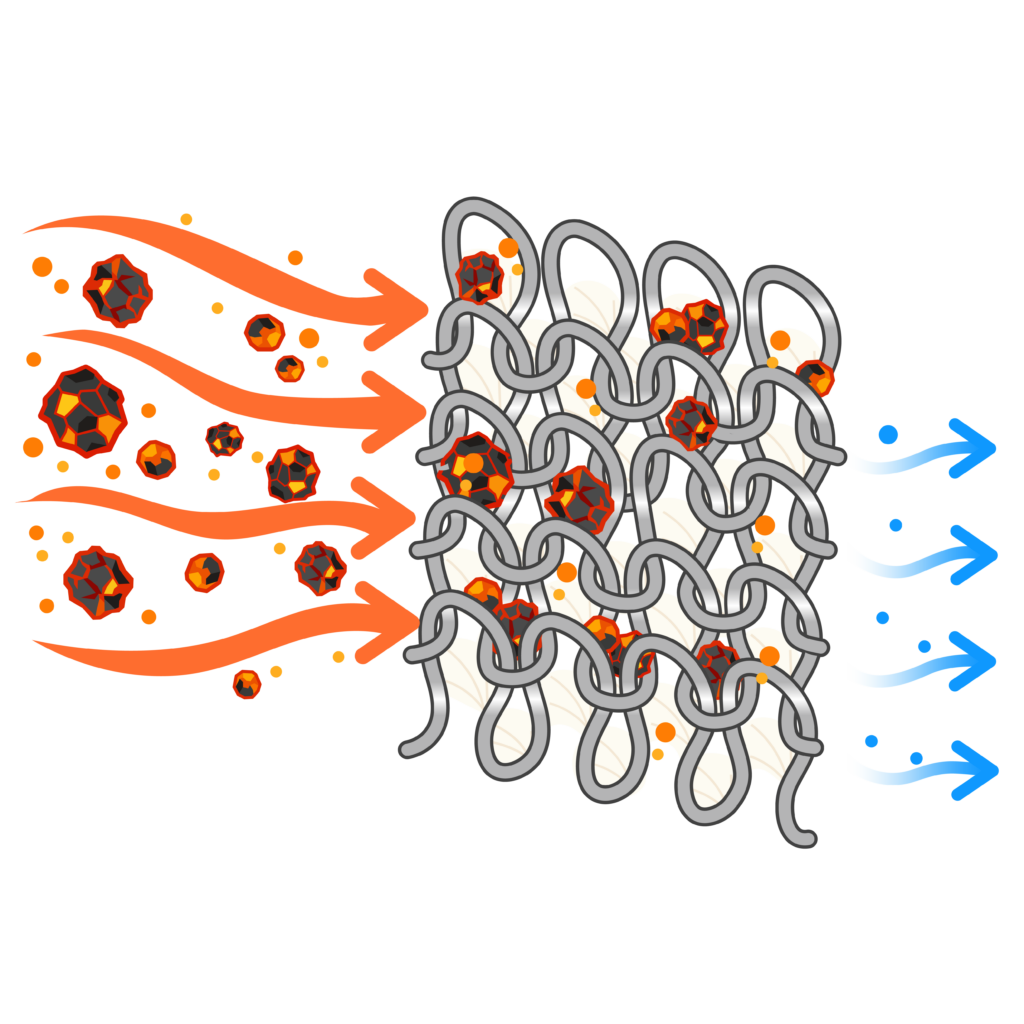
Hybrid protective effect in combination with flame-retardant fibres.
Flame-retardant fibres can be integrated directly into the knitted wire mesh structure and held mechanically by it. The metallic component ensures dimensional stability, temperature resistance, and a defined component geometry. The fibres complement the structure with an additional flame-retardant or shielding function. Since the connection can be made without additional bonding, no further organic binder is introduced into the component, which itself could contribute to smoke or pollutant development in the event of a fire. However, the specific fire and smoke behavior is always determined by the selected fibres and the entire component design.
The interplay of material, wire thickness, knitted mesh structure, compression, component thickness, and free flow cross-section is decisive. In addition, the installation situation, the thermal load, possible contamination, and the required pressure drop must be taken into account. This results not in a standard product, but in a project-specifically developed knitted wire mesh component whose structure is specifically matched to the respective fire protection function.
Key parameters for
the fire protection function.
The protective effect of a knitted wire mesh component in fire protection does not depend on a single feature, but on the interplay of several parameters. We design the component for your application using these four key parameters:
Material selection.
Wire diameter.
Influences heat absorption, mechanical stability, and dissipation behavior. Finer wires increase the surface area for heat transfer; thicker wires increase service life and robustness against temperature and load peaks.
Compression.
Determines the number of effective wire layers and thus the degree of heat dissipation, barrier effect, and spark retention. Higher density improves the protective function but influences installation space and flow resistance.
Structure.
The number of layers, geometry, and, if applicable, the combination with flame-retardant fibres determine which protective effects can be fulfilled simultaneously—from single-layer spark retention to hybrid protective structures with heat shield and fibre functions.
These four key parameters result in a protective component that fits the requirements of your fire protection concept exactly—not by chance, but by design.
Why eloona?
Because reliable fire protection is no coincidence.
It is the result of technical understanding, precise manufacturing, and close cooperation with plant engineers and fire protection planners. We listen carefully, think our way into thermal and safety-relevant load cases, and develop protective components that fulfill their function even under extreme conditions—within the fire protection requirements defined by you. Precise in detail. Clear in function. Strong in effect.
This is how components are created that do not push themselves into the foreground—but make the difference exactly where it matters.
Frequently asked questions about knitted wire mesh in fire protection.
What functions can knitted wire mesh perform in fire protection?
Knitted wire mesh is used in fire protection primarily for three tasks: heat dissipation via the metallic structure, mechanical retention of embers and sparks, and as a carrier structure for hybrid protective designs with flame-retardant fibres. Which function dominates depends on the specific application and the fire protection concept.
Are eloona's knitted wire mesh components fire-certified?
We supply knitted wire mesh components as functional parts. Certification of the overall system—for example according to DIN 4102, EN 13501, or other applicable fire protection standards—is carried out by the plant engineer, fire protection planner, or system integrator. We provide support with documented material data, clear material certificates, and production according to DIN EN ISO 9001:2015.
What is the difference between fire protection and explosion protection with knitted wire mesh?
Both applications use similar physical effects—heat absorption, barrier effect, spark retention—but pursue different protective goals. Fire protection aims to limit the effects of heat and flames on components, systems, and rooms. Explosion protection aims to control sudden energy releases in closed systems, such as in flame arresters or pressure relief systems. A knitted wire mesh component can be used in both areas—but the design differs significantly.
What is the difference between fire protection fabric and knitted wire mesh?
In common usage, both terms are sometimes equated, but technically they differ significantly. Fire protection fabrics are usually textile fabrics—mostly made of glass, aramid, or mineral fibres—with a two-dimensional structure. Knitted wire meshes are metallic, three-dimensional structures made of knitted wires. Knitted wire meshes offer higher mechanical stability, better heat dissipation, and formability into complex geometries; fabrics are more suitable for flat applications. In hybrid protective structures, both can be combined.
Which materials are used for knitted wire mesh in fire protection?
Up to what temperatures can knitted wire mesh be used in fire protection?
What role do flame-retardant fibres play in combination with knitted wire mesh?
In hybrid protective structures, the two materials complement each other: the metallic knitted wire mesh structure provides mechanical stability, heat dissipation, and high-temperature strength. Flame-retardant fibres complement the protective effect in the low-temperature range, seal the structure, and can reduce smoke development. This creates components that can cover multiple load cases simultaneously.
How do I find the right knitted wire mesh component for my fire protection application?
Describe your application to us: the overall system, the required temperature range, the expected load (heat, sparks, flame exposure), normative requirements, and the planned installation situation. On this basis, we will work with you to develop the appropriate protective component—from the initial design to the ready-to-use solution.
Let’s talk about
your fire protection application
Are you developing a fire protection concept—or looking for a knitted wire mesh component for an existing system with thermal loads? Describe your requirements to us: the overall system, the required temperature range, the expected load, and the planned installation situation. On this basis, we will work with you to develop the appropriate protective component.